
Signals and Field Notes #7
Learning and Innovation Observed....Gratias vobis ago quod legitis

Well I went and got invited to be on with Dominik Kovac’s (CEO of Coloyssan) podcast for the The Business AI Playbook. I talked a lot and Dominik is a great interviewer so I hope I said something valuable. Check it out here. Thanks to Dominik for the invite and great chat!
Anthropic launches new push for enterprise agents with plug-ins for finance, engineering, and design: This announcement definitely created some anxiety when it came out. Here’s a particularly anxiety-inducing quote > > “The stock plug-ins included at launch take aim at particular departments present within most companies, including agents designed for finance, legal, and HR departments. Each plug-in includes basic skills common across different companies, although Anthropic expects that companies will modify each plug-in to bring it in line with unique needs and customs.” What I’ve come to think is that AI is not coming for your job - they CEO might be but that’s not AI’s fault - but AI is coming for your tasks. Its coming for your ToDo list. The challenge will be to create a new To Do list that has tasks on it that not only add value but are difficult for AI to replicate.
Thinking—Fast, Slow, and Artificial: How AI is Reshaping Human Reasoning and the Rise of Cognitive Surrender: A term and dynamic to know > > “A key prediction of the theory is “cognitive surrender”-adopting AI outputs with minimal scrutiny, overriding intuition”
Ai2’s AutoDiscovery Uses AI to Find Hidden Hypotheses in Big Data: I’m hopeful about this one > > “The nonprofit AI lab has introduced AutoDiscovery, an open-source experimental tool that turns massive scientific datasets into structured starting points for new lines of inquiry. It stems from a 2025 research paper outlining a method for open-ended, autonomous scientific discovery driven by “Bayesian surprise”—a statistical signal identifying results that meaningfully diverge from prior expectations.” That last bit is the key - building divergence as a goal to search for…I just wonder what discoveries have been left behind in some of the huge data sets we have because of lack of hours to work on them.
A Roman board game has mystified researchers for years. AI discovered how to play: This is one of my stories ever, for multiple reasons. First, “Crist specializes in ancient board games” - no one told me that was a career option! Second, I love this blending of the physical with the digital “the researchers had the AI play the game against itself thousands of times, testing more than 100 different sets of rules drawn from other known European games, both modern and ancient. They compared the AI’s moves with patterns of wear on the board, tracking which gameplay styles most closely matched the grooves on the stone.” Third, you can actually play this game now > > “Crist and his team uploaded a simulation of Ludus Coriovalli to Ludii, and it’s available to anyone who wants to give it a try.” Finally, the idea of a game and its rule set as a rich artifact from which we can drawn nuanced ideas about people in the past, what was important to them, what they thought of as valuable goals, etc - is a rich and powerful idea that I hope gains more and more traction.
Meet Perplexity Computer: A Model-Agnostic AI Platform That Automates Research, Coding, and End-to-End Project Deployment: “What sets Perplexity Computer apart technically is its massively multi-model orchestration layer. Rather than routing every request through a single foundation model, Computer draws on a pool of 19 frontier AI models and assigns each subtask to the model best suited to it.” > > Is this a shot across the bow of Claude-in-Chrome? Orchestration is the word of the moment. Prompt engineering is so 12 months ago, and saying “agentic” is already equivalent to OK Boomer. See also: Perplexity may have built a better OpenClaw.
Where Senior Leaders Are Struggling with AI Adoption, According to Research: Love this article - feel more like journalism than a preachy “what you’re doing is wrong.” And I love this conclusion “Across interviews, leaders described the psychological and relational challenges of AI integration: explaining what was changing, clarifying what mattered, and responding to mixed reactions across their organizations. In this environment, leadership behavior became more visible. How leaders framed priorities and role-modeled adaptability influenced how others engaged. While investment often focuses on technical capability, leaders shape adoption through foundational skills: judgement, empathy, and adaptability.” Hope some leaders read this.
Anthropic’s Claude can now absorb your past conversations with other AI chatbots: Two things - one, this is a brilliant way to drain other moats. Two, I really do hope (but actually doubt) that we could see a rebirth of adversarial interoperability.
Google’s Gemini rolls out Canvas in AI mode to all US users: There is no way there is any company that’s ready for this. That being said, there are companies that are more ready than others. I’d still hold to my position that tools like this and Claude-in-Chrome and Claude Code - tools that aren’t creating text or images but creating apps, games, or other digital experiences. How are you going to judge if they’re any good? Should you keep them? How do you scan for security? How do you build a performance review system that rewards people for building amazing ones? All that adds up to not ready. > > “Google previously suggested using Canvas for tasks like building a study guide by uploading class notes and other sources; the feature can also complete other tasks such as turning a research report into a web page, quiz, or audio overview, which has some overlap with Google’s research tool Notebook LM. Users can describe an idea to Canvas and watch as it generates the code to transform that idea into a shareable app or game. The feature can also be used to help refine creative writing drafts and get feedback on projects.”
LearnWorlds lets you build a full online course business with AI: Now look, this “article” is an ad (says “offer” right at the top but in small font and grayscale). There are two signals here though. First, we are going to see more and more of this and the article right before this one is why. I’m freaked out by what I can build in 5 minutes and then I look over at people like Josh Cavalier and Melissa Milloway and what they can build and folks that talented could build multiple companies in a month. So #learninganddevelopment companies will be eaten from the bottom up. Second, the dynamic behind this is one that I’ve ranted on before. #L&D has become seen mainly as the generator of compliance training and has always struggled to tie its efforts to the bottom line - that means the barrier to adoption for technologies/companies like this will largely be cost-driven and we’ve done a poor job in general of making the point about why our output is worth the money.
I tested 200 edtech tools. These are the ones worth using: Some interesting ones on here.
Meta Considers Adding Facial Recognition To Its Smart Glasses: Hard pass. And the reaction will remind me of how Google Glass was received. If deployed, absolutely will be abused instantly. > > “Meta’s exploration of facial recognition technology for its smart glasses, internally referred to as “Name Tag,” represents a significant step in blending artificial intelligence with wearable devices. As Steven Sullivan explains, this feature could enable users to identify individuals in real time by analyzing facial features and cross-referencing them with online data.”
AI won’t replace strategy: It will expose it: Could not agree more and think I said as much here in this podcast with Dominik and Coloyssan > > “I’ve argued previously that the next layer of advantage in corporate AI will not come from owning infrastructure, but from building better internal models of how your business world actually works. I’ve also warned that reducing AI to a headcount-reduction tool is strategically myopic, because general-purpose technologies rarely deliver their true value through simple efficiency programs.”
Scientists make a pocket-sized AI brain with help from monkey neurons: Can something be both encouraging and terrifying at the same time? > > “We want to take these big clunky models and try to compress it down into a much smaller, compact form,” he says. They started with a model trained on data from macaque monkeys. Then they looked for parts of the model that were redundant or unnecessary. They also applied statistical techniques like those used to compress digital photos. The result: a model small enough to put in an email attachment.”
I turned my life into a video game with ChatGPT for 7 days — and I got more done than ever: You have my attention…do go on > > “To kickstart my real-life RPG adventure, I presented ChatGPT with this prompt: “Turn my real life into an RPG. Create a character sheet with stats (health, productivity, charisma, wealth, and creativity), experience points, a leveling system, daily quests, and weekly boss battles.” I kinda love this and the top reason may be a surprise. Look a couple stories up about AI and strategy. Same dynamic applies here. You can tell the AI to automate a lot of processes but what you can’t have it automate is the design. Just making someone walk through the thinking that you’d have to do to build a decent version, would be eye-opening in a “know thyself” way.
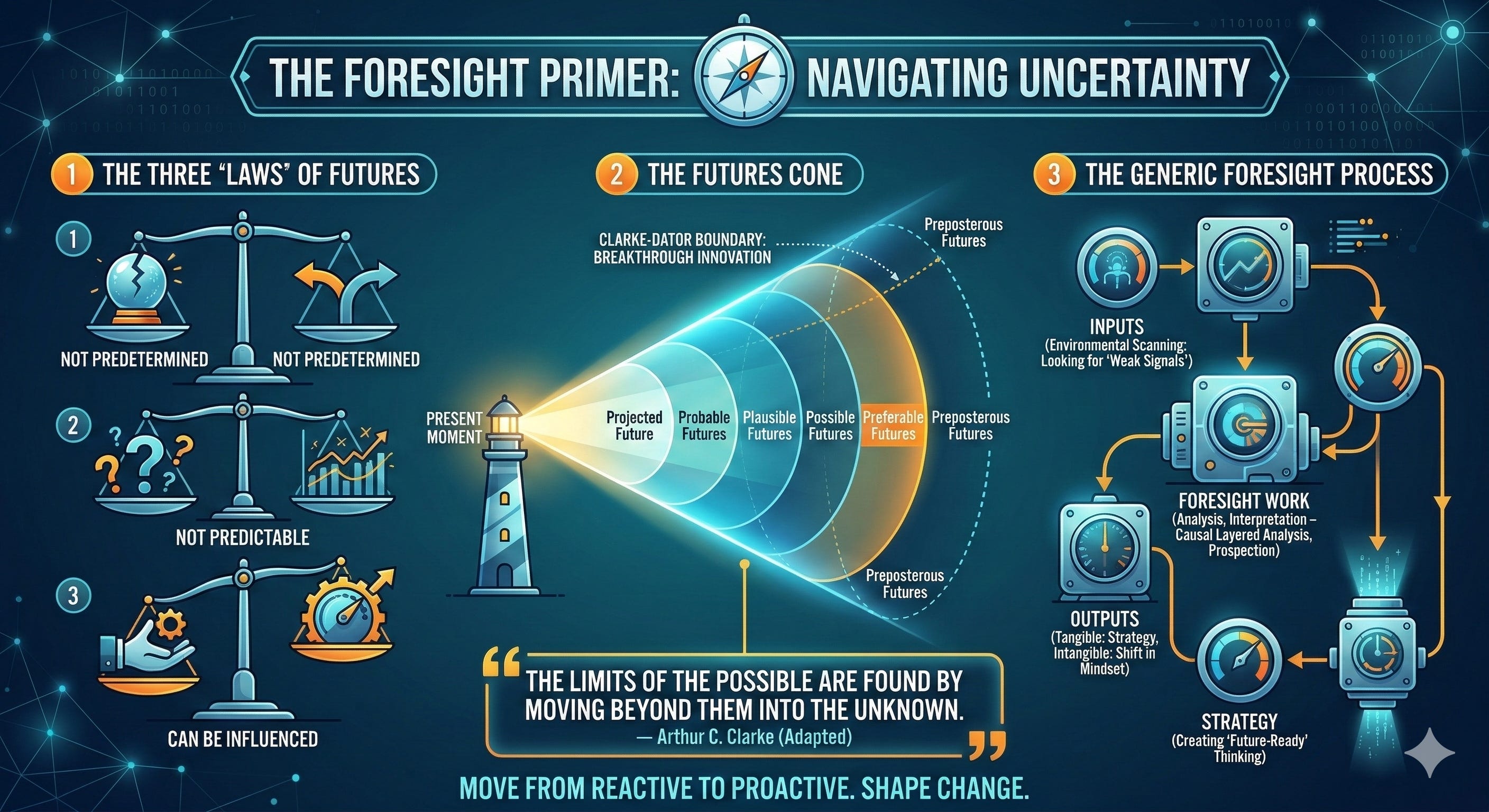
A primer on Futures Studies, foresight and the use of scenarios: This is a solid primer on the practice of foresight.
Moltbook: The conversation we should be having: Oh my but this is SUCH an interesting take! > > There’s some great writing in here about the cost, both in dollars and in environmental resources, that something like Moltbook costs BUT this next bit is what got me > > “Every man is made by a woman. They are likely fed, cared for, and taught by women. Women create everyone in the world, which is a problem for the narrative of superiority that men (not all, but at large) have created for themselves. Why else did men write the story of Eve coming from Adam’s rib? Looks to me like the original gaslight. Is the quest to create a new species that supersedes humanity, perhaps at the cost of humanity’s extinction, born out of womb envy? Creating human-like AI is perhaps subconsciously a way for these men to give birth and cut women out of the loop. That’s why they’re so bent on proving how human AI machines can be.” > > Sometimes its helpful to get a reminder that “technology” isn’t yet self-creating - there’s always substantial human involvement and humans tend to bring all their baggage with them when they create something and we can read those meanings in their creations.
How Fritz Lang’s Metropolis Created the Blueprint for Modern Science Fiction (1927): I really can’t imagine why I tell people all the time to read (and watch) science fiction. “A vast, miserable proletariat squanders its days in meaningless toil. Society is under the control of ultra-wealthy business magnates. In order to pacify the underclass, the ruling class pins its hopes on a technological solution: artificial intelligence. Welcome to the year 2026, as envisioned in Fritz Lang’s Metropolis. The new short documentary from DW above examines the making and legacy of Metropolis, paying special attention to its considerable influence on much of the science-fiction and dystopian cinema since. 2001: A Space Odyssey, Star Wars, Blade Runner, Terminator 2, Madonna’s “Express Yourself” video: these are just a few of the productions that take no great pains to hide — and in some cases, even emphasize — their debt to Lang’s vision.”

Yes, that’s what it looks like in my head.

Congrats on the podcast and thank you for your consistent posts.
I suspect you are regarding your take on internal corporate AI. I'll point to projects like OpenCode that show the orchestration is more important than the models-- consumers or prosumers may use Claude for Code because of the pricing model but enterprises have different price sensitivities work when the product is just better.