
Signals and Field Notes #20
Learning and Innovation Observed....Gratias vobis ago quod legitis

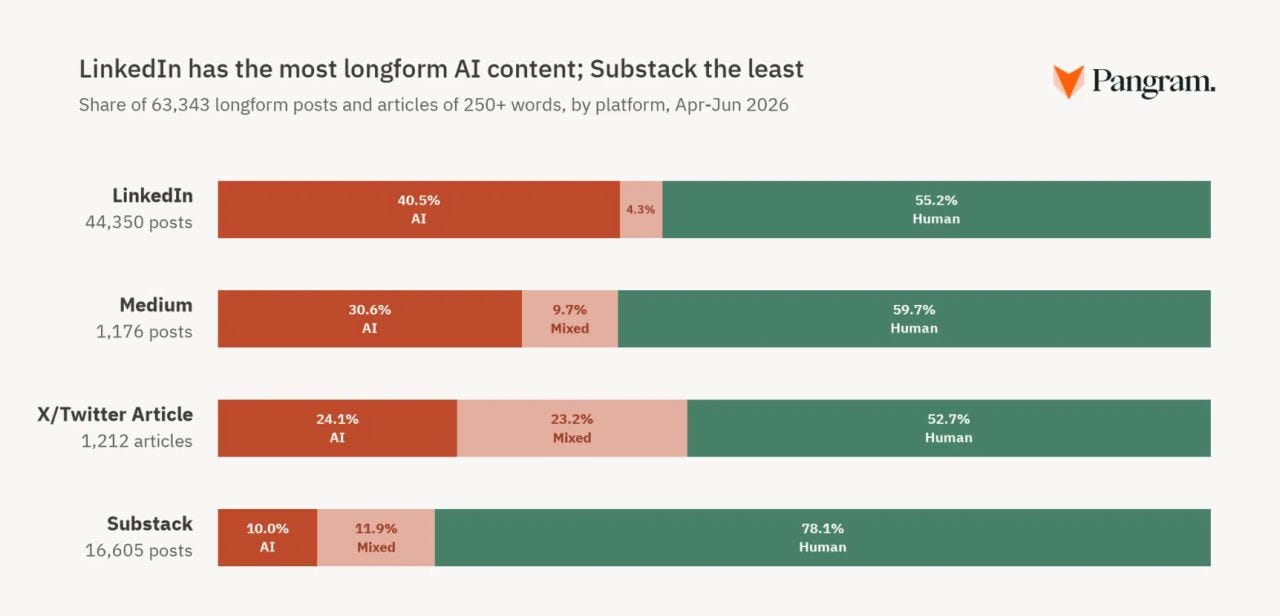
Just think, you have an almost 80% chance that this newsletter was written by a human. Of course, that’s exactly what an AI would say…..
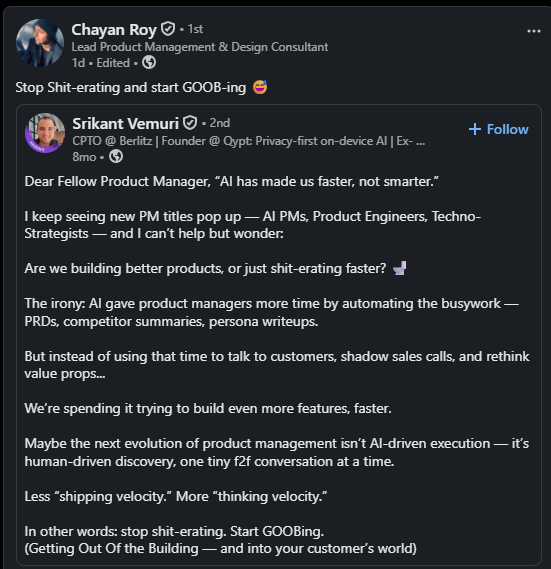
I just love this thinking. Are we doing better things, more valuable things or are we doing the same old things faster?
More thinking along these same lines - TIME SAVED ISN'T THE SAME AS VALUE CREATED - Great thinking from Conor Grennan and I think he and I are aligned but just at slightly different angles…he argues for a mindset and I still like the literacy/fluency model more.
“AI is everywhere. The agentic organization isn’t—yet” (McKinsey, April 2026) - h/t to Stuart Winter-Tear for this one - transcript of a podcast but READ this Q&A:
Q: Judgment is developed over time. How do junior employees develop the skills to oversee AI without the hazing grunt work their leaders did in the pre-agentic era?
A: This is the billion-dollar question. If you eliminate every new software engineer, you have a very expensive model of only senior folks. If you roll that movie forward ten years, you’re also missing the next generation of talent you need. The investment in learning and development is a bit of a sidecar. It’s viewed as important. It’s certainly valued by employees. But it runs periodically. In the future, I think it should be at the center of the journey people go on as employees, because the next generation will have access to all these tools from day one. So while they may not have the pattern recognition of 20 years of reviewing case law, they also won’t have the hurdle of being 20 years into a career and trying to figure out a massively disruptive and powerful technology for the first time. So leaders should ask, “How do I make that access from day one actually work to their advantage? > > That’s JUST a senior partner at McKinsey talking about the central position that LEARNING AND DEVELOPMENT should occupy. Will L&D teams step up, shake off old ways, old deliverables, and command that space?
Google renames NotebookLM to Gemini Notebook and expands code execution to Pro users: This and the recent update to Notebook’s powers, keeps this tool in the top tier of AI tools and one that I think still flies under the radar for some reason > > “The name change arrives alongside a significant expansion of the tool’s most powerful feature. Last month, Google gave every notebook a secure cloud computer capable of writing and running code against a user’s uploaded sources, enabling complex data analysis, charts, and new output formats including spreadsheets and slide decks.”
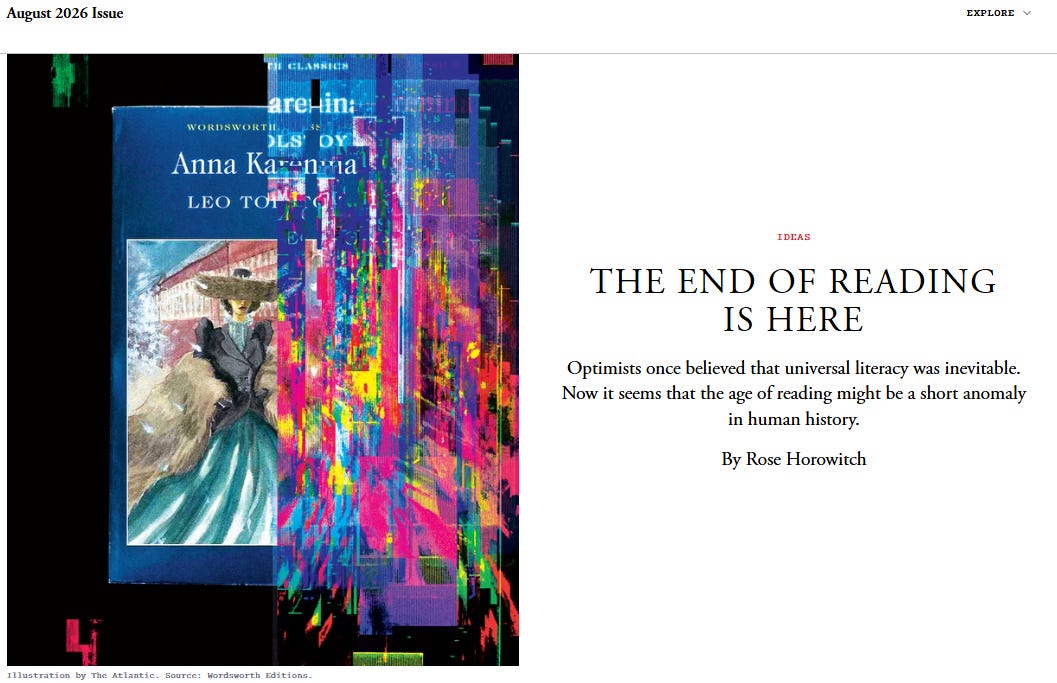
(gift link) You should read this article.
I have spent a lifetime reading and being surrounded by books. I cut my teeth on hard scifi and worked through every book I could find on mythology before I was teenager. When I was in grad school, I could measure each semester’s reading load by the shelf. I even have a tiny, little tendency not to trust people who don’t have books in their house as quickly as those that do. This article hit me hard.
There is also no way to post this without being slapped around by irony. To be clear, I include quotes here from this article not as a way of replacing it but to hopefully entice you to read the whole thing (even ironic that I name an article as the “whole thing” and not a book). I worry about this trend in a way that’s not about book sales but about what we lose when we don’t read long form texts. We lose the capacity to focus on complex ideas for extended periods of time. That’s a problem that compounds over time as it spreads. I don’t know how to reverse or fight this but maybe this article is a first step...like admitting you have a problem.
> On the destruction of the Library of Alexandria: “It is not that the disappearance of a library led to a dark age, nor that its survival would have improved those ages,” the classics scholar Roger Bagnall has written. The fact that the library was allowed to die showed that the dark age had already arrived.”
> “According to the National Endowment for the Arts, which conducts the most comprehensive survey of the nation’s reading habits, fewer than half of all adults reported having read a book of any kind in 2022. Only 38 percent read a novel or short story. A study analyzing 236,000 responses to the American Time Use Survey found that the proportion of Americans who read for pleasure on any given day fell from 28 percent in 2004 to 16 percent in 2023.”
> “Reading is more than a skill, or one mode of communication among many. The media we use to interact with one another shape the world we inhabit. Early humans spent millennia communicating only by voice. The advent of reading and writing transformed society. It altered people’s consciousness and politics, along with the intellectual feats they were capable of.”
> “Reading books is a workout for the attention span. The more you read, the easier it is to read, and the more you’re rewarded with new understanding. Eventually the process is more pleasurable than it is challenging.”
> “Writing is hard because the writer is learning. If AI eliminates the challenge, it also eliminates the learning.”
> “But the threat of apathy remains. What we’re losing is the ability and inclination to read those texts. An astonishing wealth of information and wisdom has been bequeathed to us. What we’ll do with this inheritance is up to us.”
You Will Own Nothing and Be Happy. PlayStation’s New Digital Ownership Policy Is Alarming: While not landing squarely in learning and/or innovation, the concepts of buying and owning are foundational. This latest move from Sony is a signal of how far we’ve gone down that road. It also includes the deepening erosion (at least in the U.S.) of the right of first sale. That right meant that when you bought something, like a book or a CD, you could legally resell that physical item. Digital goods are largely excluded from that. You don’t actually “own” the software or content. This is one of those “happening slow until it happens real fast” dynamics > > “Whenever I “buy” a game, I’m not acquiring ownership; I’m simply paying for a conditional permission slip. In essence, I’m purchasing a service agreement that grants me access to a game, provided I maintain an internet connection, abide by Sony’s rules, and, most importantly, recognize that Sony retains the rights to host that file.” See also: An All-Digital Gaming Future Makes Sense. Just Let Us Own Our Video Games.
‘The SaaS apocalypse is overrated’: How Workday and other software providers plan to survive AI: Nice Darwinian reminder that its not ‘survival of the fittest” but of the most adaptable. The move to ‘headless’ is already a signal in this direction - tell software companies from 7 years ago that heir UI would disappear and you’d be crazy - now its getting crazy to think about foisting your own UI onto a client > > “Gartner suggests the shift to agentic AI is less an apocalypse and more a metamorphosis. SaaS will not be destroyed; it will emerge in a different form, with the winners defined by how they respond to the threat of disintermediation.”
The rise of “comprehension debt” in the age of AI coding: When phrases like “cognitive surrender” and “comprehension debt” start entering the discussion, those are probably strong signals to consider when estimating the downstream capability of your org to think or learn its way out of a bad situation or into a good one. This dynamic holds true across almost every occupation, role, and even game that I can think of > > “For decades, the early years of a developer’s career were shaped by friction. Junior engineers learned by wrestling with compiler errors, reading documentation, and debugging unfamiliar systems. The process was often frustrating, but it helped developers build mental models of how software behaves and understand not just what worked, but why it worked.” See also: “Never-skilling: the research says juniors using AI never learn to debug” > > “A randomised trial found developers who used AI scored nearly two letter grades lower on a quiz about code they had written minutes earlier. The largest gap was in debugging.” See also: “The U.S. spent $30 billion to ditch textbooks for laptops and tablets: The result is the first generation less cognitively capable than their parents”
South Korea will give all 52 million citizens free AI access, becoming the first G20 nation to do so: This will be interesting to watch > > “South Korea’s Ministry of Science and ICT opened bidding on July 13 for a free, unlimited AI chatbot and public-service agent available to all 52 million residents. The programme, called “AI for Everyone,” would make South Korea the first G20 nation to offer AI to its entire population as a public service. Two or three companies will be selected and given up to 512 Nvidia B200 GPUs from the government, with applications open through August 11 and a beta launch in September.”
The Consensus Algorithm - Nobody wrote it. Nobody voted on it. Everyone’s executing it anyway — and a 160-year-old buried novel saw it coming: This is a wicked smart and timely reminder that the hype cycle is conjecture and anecdotal at best and we don’t have to buy into it or live by it > > “There’s a lot of AI groupthink now. Someone says something offhand on a Lex Friedman or a16z podcast…it’s a good line, so it gets clipped. The clip gets quoted without the three hours of context around it. By the third repost it’s not a soundbite anymore, it’s a consensus. That consensus becomes an assumption baked into every strategy deck in Silicon Valley, a talking point among executives, and eventually a catchphrase repeated on Capitol Hill. Somewhere in that chain, the part where anyone verified it with actual logic or actual data just sort of disappears.”
Generative AI Is an Engineering Disaster: I’m no AI doomsayer but it does seem that with the advent of AI, software engineering’s focus on efficiency, has all but disappeared. It will only return when there is either regulatory or market pressure to do so > > “But the mythological lure of AI is so strong that many engineers believe that nothing should stand in their way. Not even the basic task of writing efficient software.”
Claude’s Personality Changes Depending on the Model—And the Language You Speak: It’s almost as if language was some sort of transmitter of culture!! Quelle surprise! This is another signal that points to the need for something beyond AI or machine translation - a properly translated word carries context with it as well > > “Arabic responses tended to be more deferential, while English responses placed greater emphasis on caution. Claude was warmest in Hindi and Arabic, using more polite, playful, and encouraging language. At the same time, English and Russian responses were more rigorous, frequently challenging assumptions, correcting details, and asking for evidence. English responses also tended to provide more detailed explanations, whereas Arabic responses were generally more concise. Dutch responses were the most candid, more readily acknowledging uncertainty and mistakes, while Indonesian responses focused more on completing the user’s request.”
Economists Are Comparing the AI Boom to the Industrial Revolution—Not in a Good Way: This is the entire text of the We Must Act Now open letter > >
“A Statement on AI’s Transformation of the Economy
AI may become radically more powerful over the next 10 years.
This could drive an unprecedented transformation of our economy, larger than the Industrial Revolution, but unfolding over a vastly shorter time frame. It could bring risks, including large-scale job displacement, as well as opportunities such as major gains in living standards.
Economists, policymakers and technology leaders must act now to understand the economics of transformative AI and to build the incentives, guardrails, and institutions needed to steer AI in a direction that complements humans and benefits society.”
From the article > > “The language used in the open letter, evoking a picture of humanity that’s asleep at the wheel as it speeds towards a cliff, has also become increasingly common within Silicon Valley and tech policy circles.”
Again - I’m no doomsayer but when the signatories include folks like: Daron Acemoglu, Niall Ferguson, Paul Krugman, Reid Hoffman, Jack Clark, Yann LeCun, and several hundred more, its a signal.

I tried to parody the most absurd AI products, but the tech industry beat me to it: Within every parody is a highlighter of the truth > >
The eight-step plan for putting AI in anything > > After comparing the fake products with the real ones, I think I’ve reverse-engineered the process.
Find an object that already works without an account.
Add cameras, microphones, or enough sensors to monitor a regional airport.
Rename all that surveillance as personalization.
Turn an ordinary habit into a score.
Generate advice.
Put the history, interpretation, or useful setting behind Premium.
???
PROFIT
The finished product doesn’t necessarily complete the task. It watches you complete the task, grades the attempt, and sends a notification explaining where you could improve. Companies keep mistaking the ability to observe something for the ability to help with it.
Woohoo! Super excited to be coming back to DevLearn this year. Being on the Customer Education side of the fence has taught me a lot and I can’t wait to share it and see what you think. Come check out session: 408: Same Craft, Different Customer: What Learning & Customer Education Teams Can Learn from Each Other
See you in Vegas!

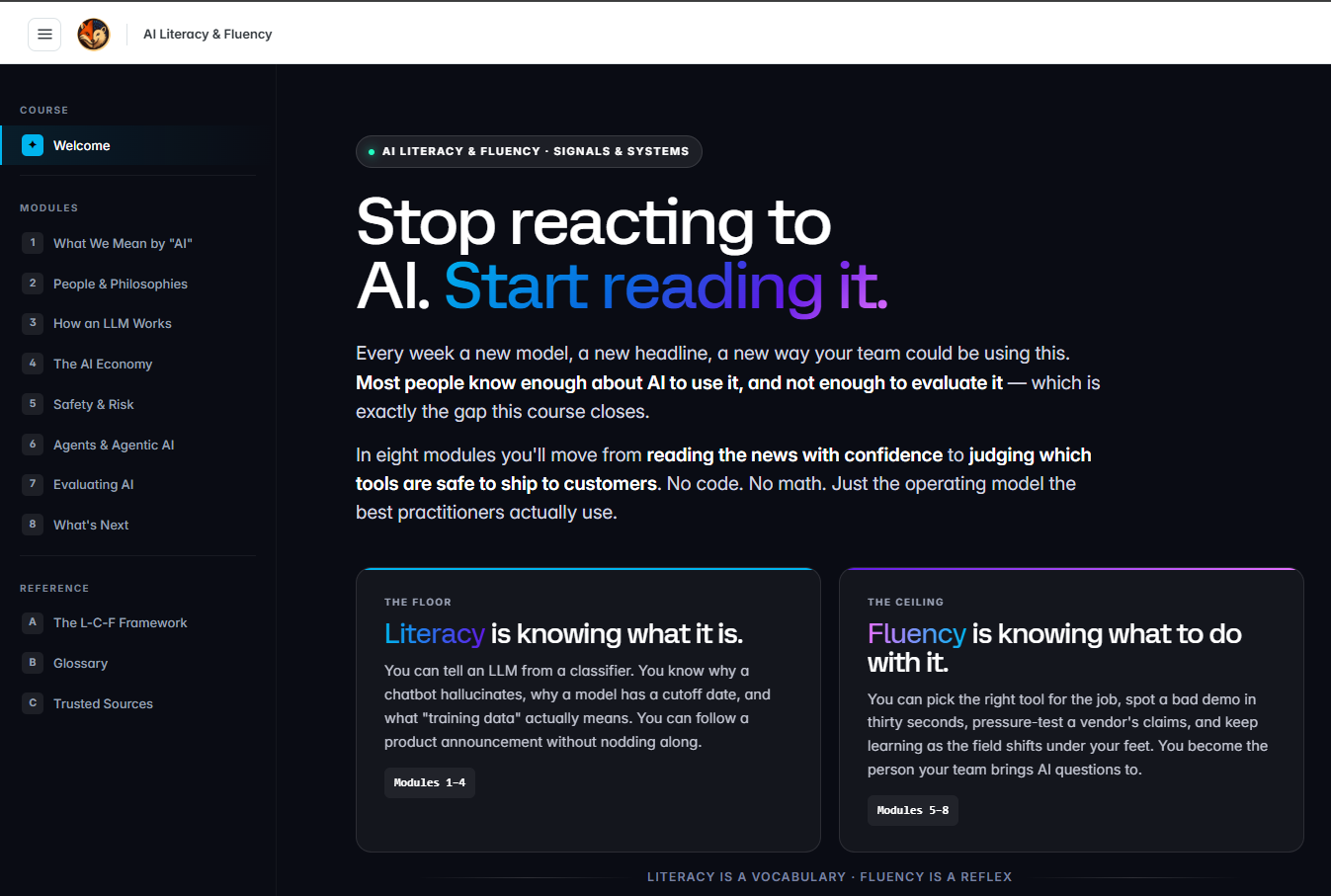
We need to be building literacy and fluency around AI, not just memorizing the latest “ultimate prompt cheat sheet” - I created this course to help: AI Literacy and Fluency.