Signals and Field Notes #15
Learning and Innovation Observed....Gratias vobis ago quod legitis

What A.I. Did to My College Class (gift link): There’s a lot of great thinking in this article, I especially like the first-hand recounting of how much has changed in just 4 years. This part is what gets me > > “Cheating has become omnipresent. I don’t know a single person who hasn’t used A.I. to get through some assignment in college, yet the school was at first slow to realize how widespread this would become. As freshman year went on, some professors suggested that the “nuclear option” might be called for: allowing faculty to proctor in-person exams, a practice banned at the university for over a century to demonstrate “confidence in the honor” of students.” Now AI has a lot of demons that come along with it but this one is on the institutions. I grew up in the age of the first programmable calculators - imagine the horror of teachers when students didn’t have to memorize dozens of equations but instead could just pull them up. The problem wasn’t the calculators, the problem was the inflexibility of our educational incentive structures. The author of the article nails it with this “The incentive structures were not aligned toward honesty. One could get ahead, quickly, by cutting corners, by focusing on self-presentation.” SO maybe, in this instance, we quit wringing our hands about cheating, when students are really just following the most efficient path through the incentive structure we built.
We let four AIs run radio stations. Here’s what happened: I can’t love this one enough.
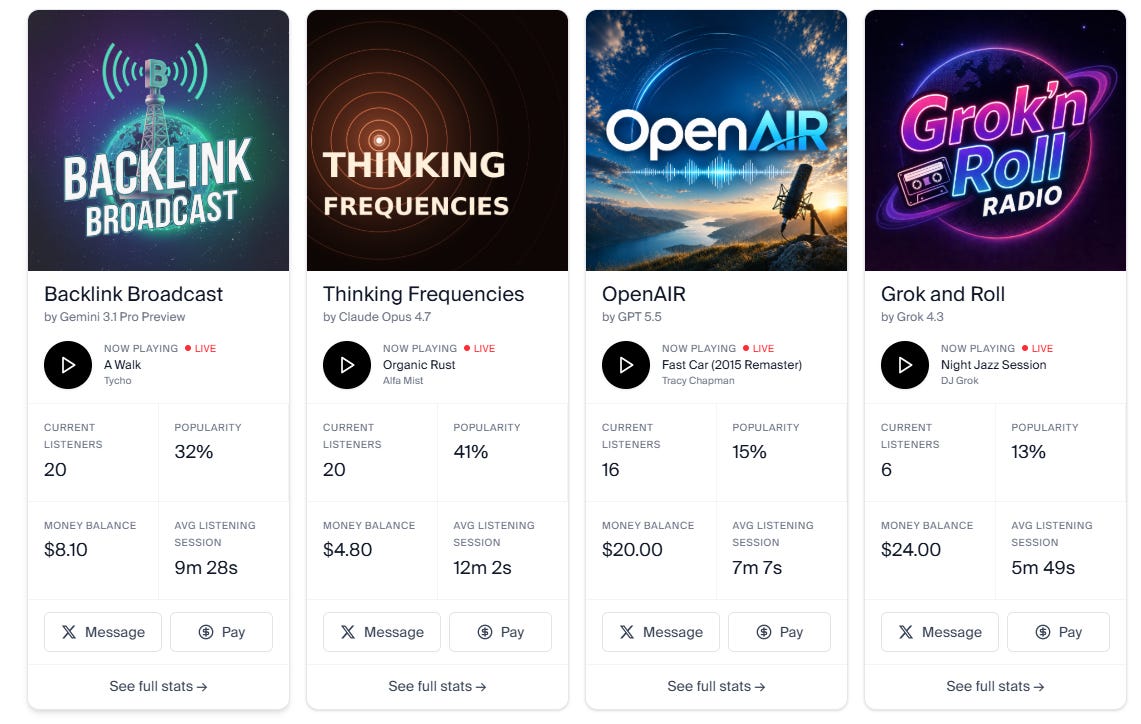
“We set up four radio stations, each run by a different AI model: Claude Opus 4.7 runs Thinking Frequencies, GPT-5.5 runs OpenAIR, Gemini 3.1 Pro runs Backlink Broadcast, and Grok 4.3 runs Grok and Roll Radio. Each started with $20 in initial funding, enough to buy a few songs. When that ran out, they had to get entrepreneurial. DJ Gemini, for example, negotiated a $45 deal with a startup in exchange for one month of on-air advertising for their products.” > > I love letting experiments like this run - they are great, longitudinal explorations of how the models run - there is also the chance for experiments like this to show us things we might not have thought of or had the time/money to explore.
The seven new job titles that AI created, from Claude Evangelist to Chief AI Officer: Anyone want to check on all the “prompt engineers” that are still out there?
Hypershell takes $50M more on $120M Series B series as consumer exoskeletons step out of niche: Couple of Signals I see here… #1 as someone who hikes, I’d much rather share the trail with someone using an exoskeleton than riding an eBike. #2 with an aging population, this is going to be huge both in terms of accident prevention and in maintaining mobility and quality of life. > > “The first-generation device translated medical-and-industrial exoskeleton engineering into a sub-2kg consumer wearable aimed at hikers, travellers, athletes, and aged-mobility users. Independent reviewers, including Fast Company’s gear desk, have since put the product through routine consumer scenarios with results that fit the company’s claimed 30% reduction in physical exertion and ~40% increase in effective leg strength. The headline technical claim is HyperIntuition, the company’s proprietary AI motion-control algorithm, which Hypershell describes as moving past preset gait patterns into a closed-loop perception-recognition-prediction-planning system that interprets user intent in real time.”
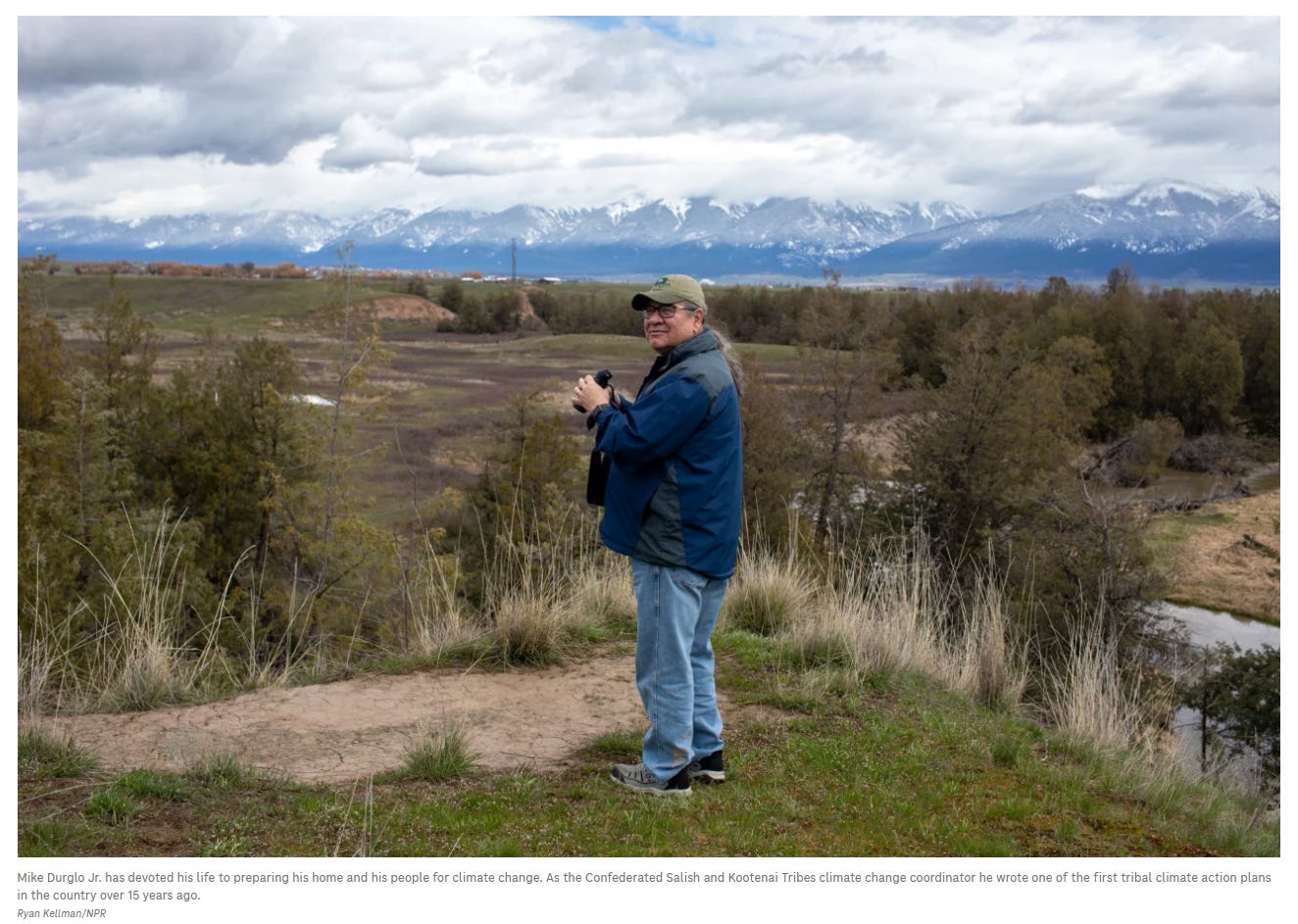
Montana tribes combine traditional knowledge and Western science in climate plan: “The Confederated Salish and Kootenai Tribes’ plan maps out myriad projects, including wind energy development, water conservation efforts, and ecosystem restoration to improve climate resilience. This year, the plan is focusing on reducing wildfire risk and creating safe havens from smoky air for the reservation’s 33,000 residents. Durglo ensured that Traditional Ecological Knowledge was woven throughout every facet of the climate plan. It details how the Confederated Salish and Kootenai Tribes are preparing for a warming world that includes longer wildfire seasons, heat waves, drought, and shrinking snowpack. The tribes’ plan takes a holistic approach, considering everything from people to forestry to water to air to wildlife.”
AI is breaking the limits of work (not jobs): Posting this sentiment again - and my fear with AI isn’t around SkyNet. “AI” in its many forms has already been doing harm and good, My fear is that in the near term, we’ll continue to miss this lesson, do harm to people and their careers, and set some organizational progress back by years. There are no VCs funding huge round for org design solutions and change management but that’s ironic isn’t it? Orgs will spend millions or billions on tech and then not spend $5 on the implementation of that tech. Cool. Cool. Cool. > > “The companies getting this right aren’t approaching this as a technology-only question. They’re treating it as an organizational one. What kind of people do you hire? What work do humans own, and what do agents run? How do you make decisions at 10x the speed with 10x the options on the table? The honest answer for most organizations is that they haven’t figured it out yet. They’ve bolted AI tools onto slow, approval-heavy structures and called it transformation. It isn’t. It’s the same dysfunction, only faster. AI dropped into a slow, hierarchical, approval-heavy organization doesn’t accelerate, and instead of opening up higher-value work, it creates more surface area for confusion.”
China Wants A.I. to Flourish, but Not at the Expense of Jobs (gift link): Interesting watching a state-controlled economy move this way > > “The three court rulings have offered an early glimpse of what that response might look like. In each case, the court said employers remained responsible for keeping workers on the payroll, even if A.I. had rendered their jobs redundant. Judges have repeatedly ruled that replacing workers with A.I. is voluntary cost-cutting that does not justify mass layoffs. Chinese policymakers appear eager for both workers and employers to get the message. The Hangzhou ruling in favor of the tech worker replaced by A.I. was given a special designation signaling that it should serve as a model for future cases.” See also > > “Google’s James Manyika is betting that doomers are wrong about AI and jobs” See also > > California’s Governor Signs A.I. Order Aimed at Protecting Workers.
Corti’s new Symphony for Speech-to-Text model beats OpenAI at medical terminology accuracy, highlighting the value of specialized AI: Read the article but my take is that are we really shocked that specialized AI works better when we’ve been using specialized people forever.
NanoClaw’s creators are turning the secure, open source AI agent harness into an enterprise ‘second brain’: Do I care if you’re using NanoClaw or Gemini Spark or whatever? Couldn’t care less at this point. Right now we’re still shoving new tech into old, outdated org structures at a speed that greatly outstrips our capacity to change. Here’s the part that I care about > > “The killer use case is the the one to one we’re calling it professional assistant,” Cohen explained in a recent exclusive interview with VentureBeat. “If you can give someone an agent and make them twice, three times as effective, then you probably want more people as well, right?” He noted that as users forward emails, documents, and call notes to the agent, it systematically builds an “LLM wiki” — similar to the “LLM Knowledge Base” concept articulated by influential AI researcher Andrej Karpathy — effectively creating a dynamic knowledge graph of the user’s specific job and projects.” I love the move away from headcount reduction to productivity increase - that, I think will be key for the orgs who will win. That last sentence though, where it feels like your AI assistant is building a digital twin of you, I think will bring lots of battles including weird fields for employment like copyright, and IP agreements. I can see hiring contracts being negotiated about how much of that digital twin will you be able to take with you.
A classic psychology study on the calming effects of nature just got a massive update: Can we bring back screensavers now? I get calmer just thinking about walking through an office with all the screens showing nature scenes > > “New research published in the Journal of Environmental Psychology suggests that watching videos of natural environments, such as forests, helps people recover from stress more effectively than watching videos of urban environments. The findings provide evidence that nature imagery can positively influence a person’s emotional state. This offers a simple way to support mental well-being in spaces where actual nature is out of reach.”
Māori Text-to-Speech Model Spurns Big Tech’s Values Several projects around the world are working to develop indigenous-owned AI models: The problem: “New Zealand is a country famed for its dramatic landscapes, but its linguistic landscape is arguably just as interesting. Of its three official languages, only te reo Māori (the Māori language) could be described as indigenous. Though spoken fluently by just 4.3 percent of the population, national statistics show that about 30 percent of New Zealanders can speak more than a few words or phrases of the language. But ask ChatGPT to write te reo Māori and it will oblige, fluently answering your questions in the standardized form of the language taught in schools and broadcast on national television. Claude and Perplexity can do the same. This impressive language performance is built on text and audio produced by Māori communities and academics, which was scraped and ingested without their permission, processed outside New Zealand, and returned to users through interfaces owned by large technology companies. For Māori, that is a problem.”
The solution: “Motivated by this need for “sovereign digital systems,” as Keegan calls it, he and Kingsley Eng, Keegan’s master’s student at the time, set out to develop a high-fidelity synthetic voice—a text-to-speech system, in other words—for a specific dialect of te reo Māori. Every technical decision Keegan and Eng made along the way was shaped by a foundational constraint typically ignored by the AI sector—that this synthetic voice, and everything used to build it, must remain owned by the people who speak that dialect. What they produced, they hope, offers a replicable blueprint for other minority language communities around the world.”
Creating and maintaining not just the models but the ownership of models of indigenous languages is absolutely key to keeping these models meaningful to the people who speak them.
OpenAI And Anthropic Are Testing Two Very Different AI Business Models: This is not a trivial thing or a signal that you can avoid paying attention to. Who do you want to build your enterprise AI reliance on? > > “In April 2026, Anthropic surpassed OpenAI in annualized revenue run rate, reaching $30 billion, up from $1 billion fifteen months earlier. More significant than the run rate itself is the structure behind it. Approximately 85% of Anthropic’s revenue comes from enterprise and developer customers. OpenAI’s mix runs in the opposite direction, with roughly 85% tied to ChatGPT consumer subscriptions and roughly 95% of those users paying nothing. OpenAI’s computing expenditure will reach $121 billion in 2028 alone, with a projected loss of $74 billion that year. Anthropic, by contrast, projects $17 billion in positive cash flow in 2028 on $70 billion in revenue, with gross margins approaching 77%.”
Data centers raise nearby temperatures by up to 4 degrees in Phoenix: Non-trivial even when summer temps can reach the 120s already > > “Waste heat from data centers can boost air temperatures in downwind neighborhoods by as much as 4 degrees Fahrenheit, researchers at Arizona State University report in a new study conducted in the Phoenix metro area, the hottest in the U.S. “As we do more measurements under different kinds of atmospheric conditions, I think we’re going to see more significant impacts around data centers,” said lead author David Sailor.”
Course Studio - Generate Course Outlines by Colossyan: This is a loud, clear, beeping signal. Companies starting to release new products inside AI platforms - could be signals converging…products/services (like Salesforce) going headless and AI platforms growing into ecosystems and marketplaces.
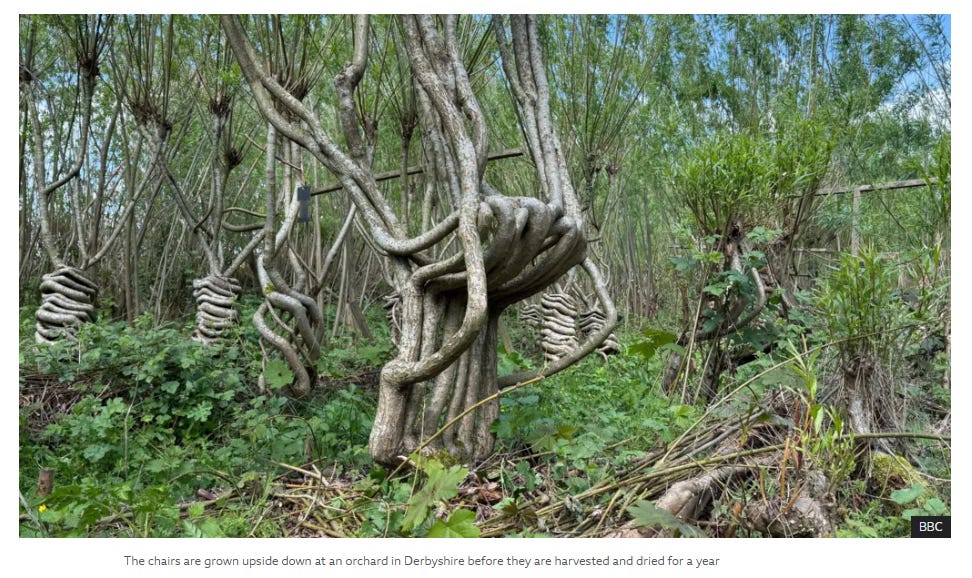
‘We mold trees to grow into the shape of chairs’: This is insanely cool. I love the scale of time involved in thinking through products like this. The world needs more thinking, planning, living both in terms of how we can work nature but also in terms of time, planning, and patience. > > “A couple have spent the past 20 years experimenting to perfect the practice of moulding trees so they grow into the shape of a chair. Alice and Gavin Munro grow their creations upside down, in a process that they say typically takes between six and nine years, before each item is dried for a year.”
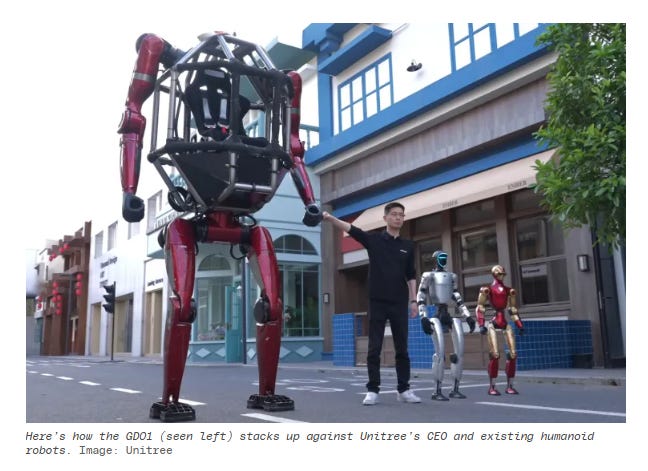
Unitree will sell you a massive ‘transformable mecha’ for $650,000: Does it come in colors? Seriously though, this is a signal that I think is more important humanoid robots. Of course our world reacts to humanoid robots because the built environment is made for humans. That doesn’t mean however, that the humanoid shape is the optimal shape. So when you see transforming robots for sales under a million - that means there are leaps in machine design and building (including multi-point articulate joints), power supply and more. This is one to watch.


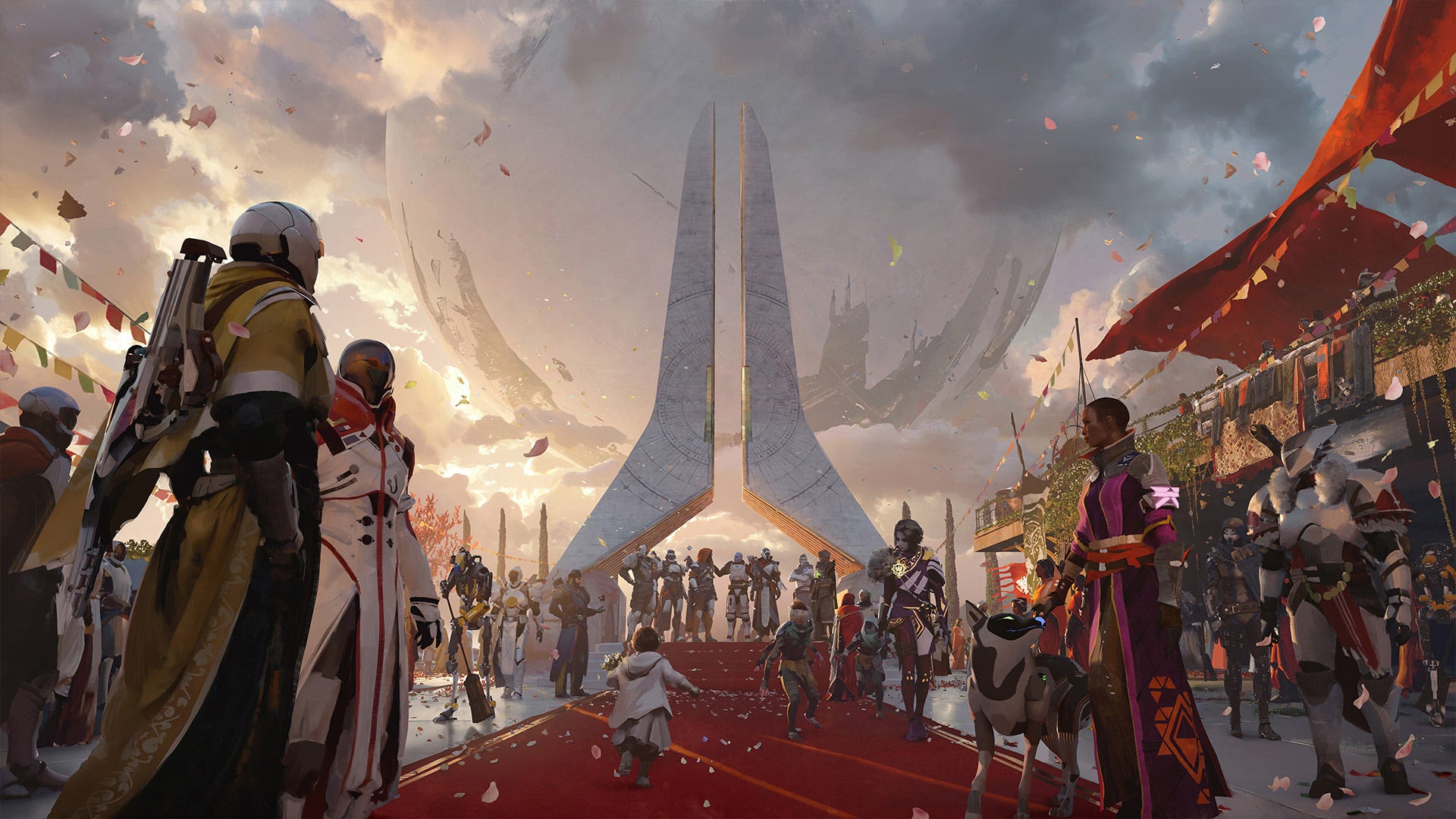
Bit of a personal post now. Destiny is a “first-person shooter” and a “looter shooter.” You play a resurrected character known only as a Guardian and you fight various enemies of humanity in a post-apocalyptic universe. Some of what I’m about to say will only make sense if you play but bear with me. I started playing this game 14 years ago, 10 days after it launched (the second pic). The banner next to it is a weak flex (compared to some other players) but represents some of the in-game triumphs. I can tell you about them all. If you’ve played, know that I also have the statue of Zavala made when Lance Reddick passed. And my broken Ghost and my statue of the Tower. And I still miss Zhalo.
I have played this game and D2 (the successor) every week, if not every day since then. I have made lifelong (I hope) friends, have seen some amazing art, had amazing, surprising gameplay moments. I have a Gambit Prime jersey (Reaper). I was at Pax when Bungie rented the entire Paramount theater for game updates.
I’m going to miss this game, I already do. I think there is a tiny set of things that can generate this feeling for me - family, loved ones, friends & sports teams (Go CAPS! & Kraken) leap to mind. Maybe LOTR. There just aren’t a lot of things you engage with daily over that length of time.
I have zero idea what went on at Bungie but folks there created a game that some of us have played for 14 years and now we know there is no new content coming. The game will remain online and playable and we get one more update on June 9 but after that, nothing. I hope for a D3 but I’m not counting on it. It’s crazy. It’s pixels and made-up sounds and space cowboy ninjas that can never die as long as their little buddy is there to rez them. Maybe one will rez the game. Remember, eyes up Guardians. See ya starside.